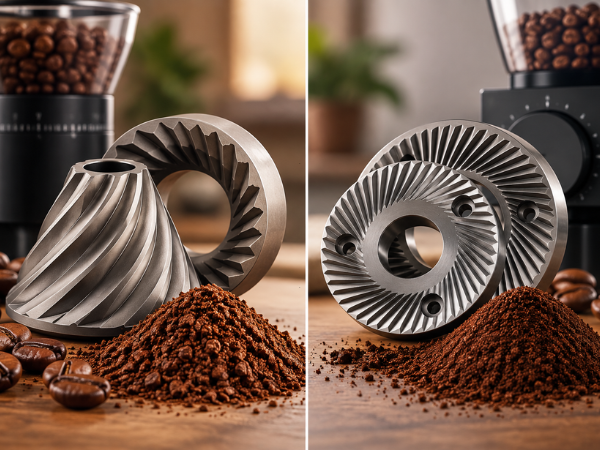
Two of the most common designs are conical burr grinders and flat burr grinders. Both use burrs rather than blades, allowing coffee beans to be crushed into more controlled particle sizes, but their geometry and grinding behavior are different.
What Is a Conical Burr Grinder?
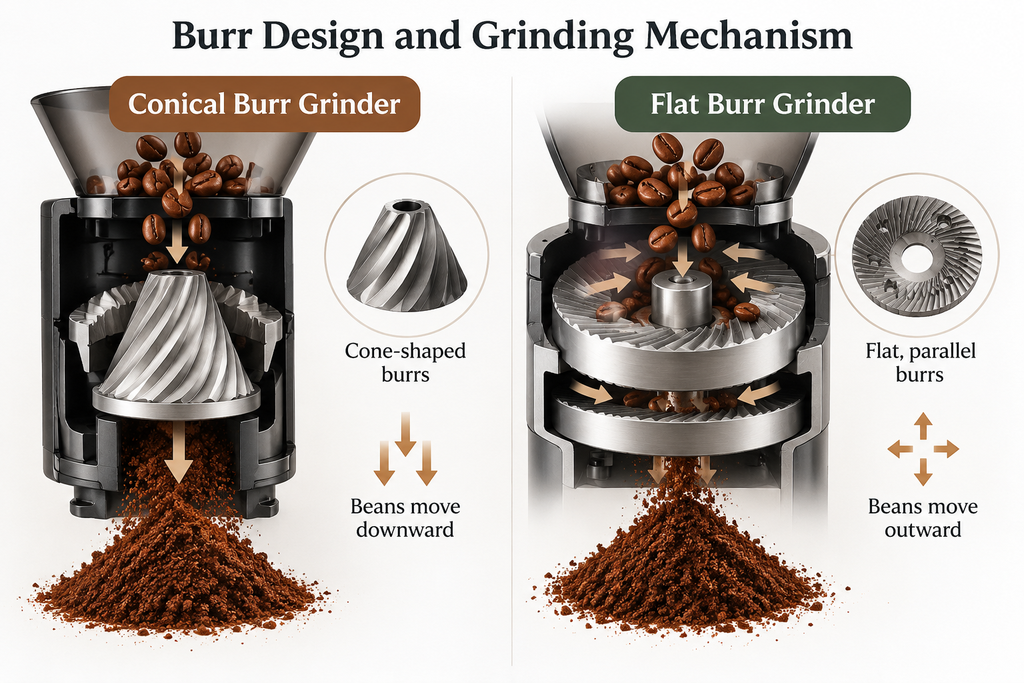
A conical burr grinder uses two cone-shaped grinding surfaces positioned one inside the other. Coffee beans enter through the center and move downward through the burrs as they are ground.
One burr typically rotates while the other remains stationary. The distance between the burrs determines the final grind size.
Common advantages of conical burr grinders
- Generally compact and practical for home use
- Often available at affordable prices
- Good control over grind size
- Suitable for espresso and filter coffee
- Many models operate relatively quietly
- Can work effectively at lower speeds
A conical design can also produce a range of particle sizes, including both larger particles and very fine particles. Whether that is an advantage depends on the coffee and brewing method.
What Is a Flat Burr Grinder?
A flat burr grinder uses two circular burrs positioned parallel to each other. Coffee beans pass between the two grinding surfaces and are broken down as they move outward.
Flat burr grinders are especially common in higher-end espresso equipment and commercial coffee environments because they can offer excellent control over particle distribution.
Common advantages of flat burr grinders
- Highly controlled particle distribution
- Excellent grind-size adjustment
- Strong performance for espresso
- Available with large burr diameters
- Popular among specialty coffee enthusiasts
- Can provide very repeatable grinding
However, a flat burr grinder isn’t automatically superior simply because it uses flat burrs. Burr material, geometry, alignment, motor, RPM, and overall grinder construction can be just as important.
Burr Design and Grinding Mechanism
The biggest physical difference is the orientation of the burrs.
| Feature | Conical Burr | Flat Burr |
|---|---|---|
| Burr shape | Cone-shaped | Flat, parallel discs |
| Bean movement | Generally downward through the burrs | Generally outward between the burrs |
| Typical design | Compact | Often larger |
| Particle distribution | Can include a broader range of particle sizes | Often more tightly controlled |
| Common use | Home coffee and espresso | Espresso, specialty coffee, commercial grinding |
This difference may sound technical, but the practical result is more important: different burr geometries can produce different particle distributions and therefore different extraction behavior.
Grind Consistency and Particle Size
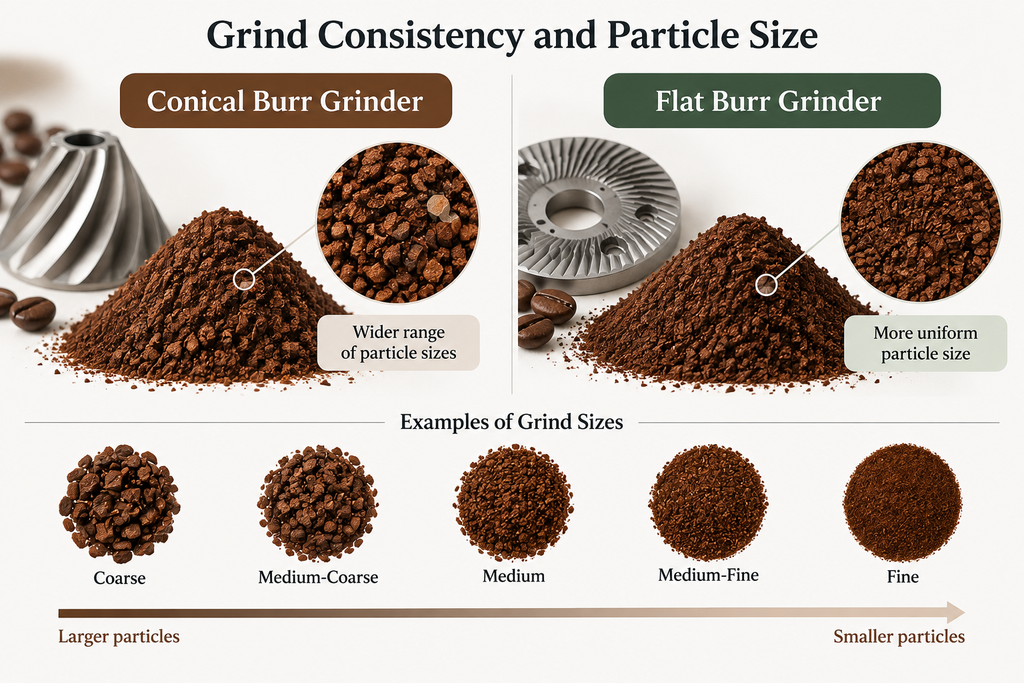
Grind consistency is one of the most important factors in coffee brewing. A balanced grind should contain particles close to the target size, while too many fines or large particles can lead to uneven extraction.
Both conical and flat burr grinders can produce excellent results, but their particle distributions may differ. Conical burrs can produce a wider mix of fines and larger particles, while flat burrs often provide a more concentrated particle distribution around the selected grind size.
However, burr shape is not the only factor. Burr geometry, alignment, and grinder quality can have a greater impact on consistency than simply choosing conical or flat burrs.
Coffee Flavor and Extraction
Different particle distributions can influence how water moves through the coffee bed and how quickly different particles release soluble compounds.
A grinder producing more fines may contribute to faster extraction from those particles. A grinder producing a narrower particle distribution can make extraction more uniform.
This does not mean one design always tastes better.
Conical burr characteristics
Conical grinders can work particularly well for drinkers who enjoy:
- Full-bodied coffee
- Traditional espresso
- Richer flavor profiles
- Milk-based espresso drinks
- A versatile grinder for several brewing methods
Flat burr characteristics
Flat burr grinders are often attractive to people looking for:
- Clearer flavor separation
- High extraction potential
- More precise espresso preparation
- Greater control over particle distribution
- Specialty coffee brewing
However, these are general tendencies rather than guarantees. The coffee beans, roast level, burr geometry, grinder alignment, brewing recipe, and water all influence the final cup.
Espresso Grind and Extraction
The coffee must be ground finely enough to create the necessary resistance to water while remaining consistent enough for controlled extraction. Even relatively small grind adjustments can noticeably change espresso flow.
A conical burr grinder can be a very practical choice for home espresso, particularly when convenience, size, and price are important.
Flat burr grinders are often favored by enthusiasts who want very precise control over espresso extraction. Some models also provide extremely small adjustment steps, making it easier to fine-tune a shot.
For espresso, look beyond burr shape and examine:
- Burr diameter
- Burr geometry
- Adjustment mechanism
- Burr alignment
- Motor performance
- Grind retention
- Dosing consistency
- Ability to make small grind adjustments
A quality conical grinder can outperform an inexpensive flat burr grinder, so burr shape should never be the only purchasing criterion.
Heat, Noise, and Grinding Speed
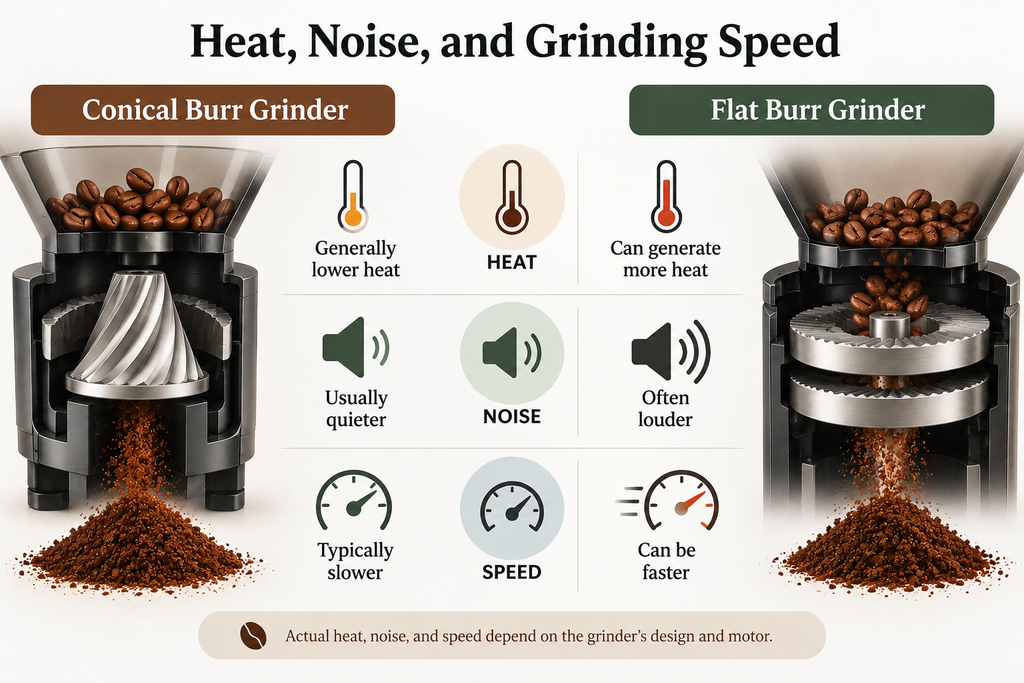
Grinding creates heat from the motor and friction, but the actual effect on coffee depends on the grinder’s design and how it is used.
Conical burr grinders often run at lower RPM and can be a practical choice for home brewing. Flat burr grinders vary more widely, with some models using larger burrs and powerful motors for faster grinding.
Noise is influenced by the motor, RPM, burr size, housing, and overall grinder construction, not just the burr shape.
For everyday home use, grinding speed, noise level, and heat management can be more important than the difference between conical and flat burrs.
Coffee Retention and Dosing
Retention refers to coffee grounds that remain inside the grinder after grinding.
This matters because retained coffee can affect the accuracy of the next dose. It can also become stale if it remains inside the grinder for an extended period.
Both conical and flat burr grinders can have low or high retention depending on their internal design.
For users who change beans frequently, look for features such as:
- Short grinding paths
- Accessible burr chambers
- Minimal dead space
- Effective grounds ejection
- Easy cleaning
- Single-dose-friendly design
If you weigh every dose before grinding, low retention is particularly useful because the amount of coffee entering the grinder should closely correspond to the amount coming out.
For users who keep the same beans in a hopper, retention may be less important than repeatability and dosing convenience.
Choosing the Right Burr Grinder for Home Coffee
Conical burr grinders are often recommended for beginners or casual coffee drinkers because they are quieter, easier to clean, and more affordable. Flat burr grinders, on the other hand, are favored by espresso enthusiasts who demand exact grind uniformity for consistent extraction.
- Budget – Conical: cost‑effective; Flat: pricier, pro‑level.
- Flavor – Conical: body & depth; Flat: clarity & brightness.
- Methods – Conical: French press/pour‑over; Flat: espresso.
- Maintenance – Conical: easier cleaning; Flat: more upkeep.
- Noise/Space – Conical: quieter, compact; Flat: louder, bulkier.
When choosing a grinder, think about how you brew most often. If you enjoy experimenting with multiple methods, a conical burr grinder offers flexibility and ease of use.