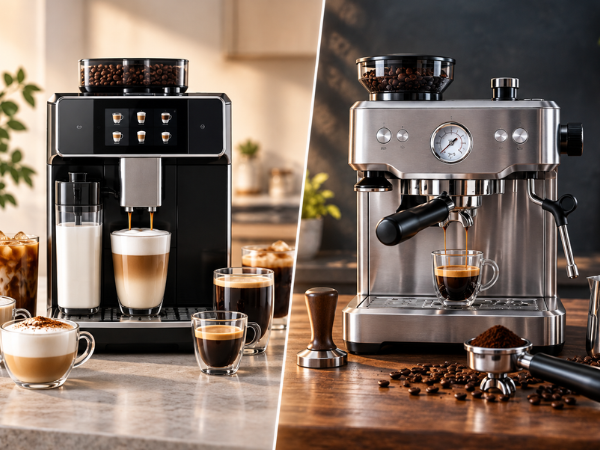
The main difference is simple: automatic coffee machines handle more of the brewing process for you, while semi-automatic machines give you more control over each step. Your ideal choice depends on whether you prioritize speed and convenience or hands-on espresso preparation.
What Are Automatic and Semi-Automatic Coffee Machines?
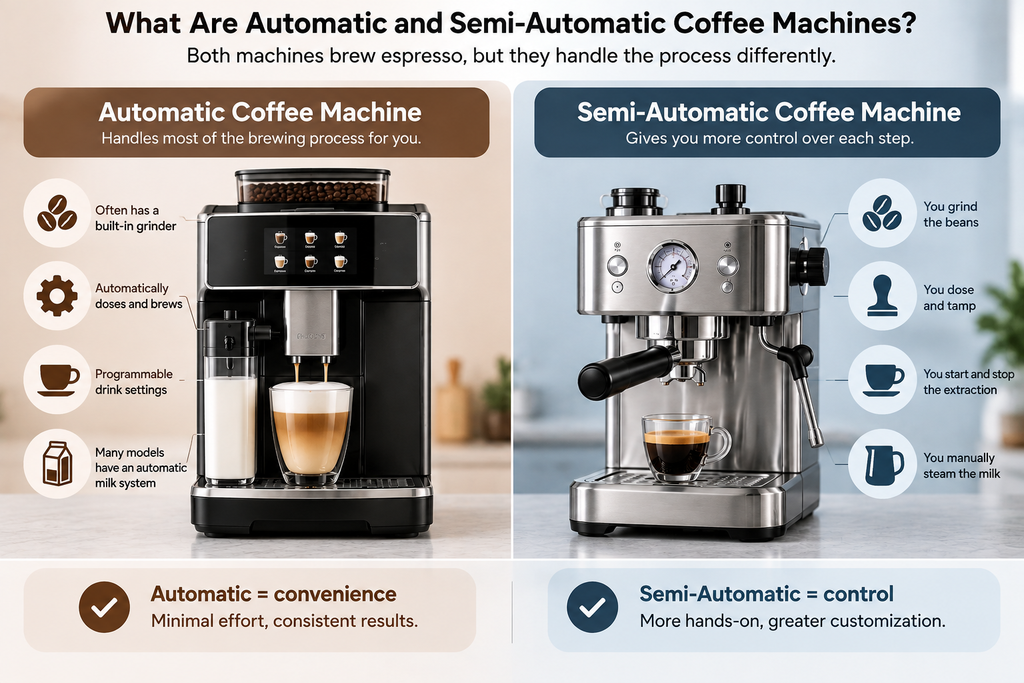
Automatic and semi-automatic coffee machines are both designed to brew espresso, but they approach the process differently.
An automatic coffee machine controls key parts of the brewing process, such as water delivery and shot timing. Many models also include built-in grinders, programmable drink settings, and automatic milk systems.
A semi-automatic coffee machine requires more manual input. You typically grind and dose the coffee, tamp the grounds into a portafilter, lock it into the machine, and start and stop the extraction yourself.
Automatic vs Semi-Automatic: How Do They Work?
The two machines use the same basic espresso principle: hot water is pushed through finely ground coffee under pressure. The difference is how much of the process you control.
With an automatic machine, you usually select a drink or press a programmed button. Depending on the model, the machine can grind the beans, dose the coffee, brew the espresso, and dispense the drink with minimal effort.
A semi-automatic machine gives you more responsibility. A typical workflow looks like this:
- Grind the coffee beans.
- Measure the desired dose.
- Distribute the grounds in the portafilter.
- Tamp the coffee evenly.
- Lock the portafilter into the group head.
- Start the extraction.
- Stop the shot when you reach the desired yield.
- Steam and texture milk separately if making a milk-based drink.
This additional work is not necessarily a disadvantage. For many espresso enthusiasts, it is part of the appeal.
Popular Automatic vs Semi-Automatic Coffee Machines
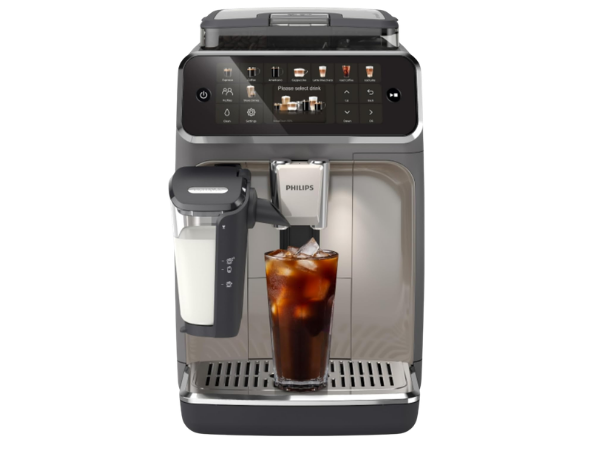
Philips 5500 LatteGo
| Type | Automatic Coffee Machine |
|---|---|
| Drink Presets | 20 Hot & Iced Coffee Presets |
| Milk System | LatteGo Automatic Milk System |
| Grinder | Ceramic Grinder |
| Brewing Pressure | 15 bar |
| Capacity | 1.8 liters |
| Brewing | Automatic grinding, tamping and brewing |
| Customization | Coffee strength, volume and milk preferences |
| User Profiles | Up to 4 profiles |
| QuickStart | Ready to brew in 3 seconds |
| Milk Cleaning | 3-part system; dishwasher safe |
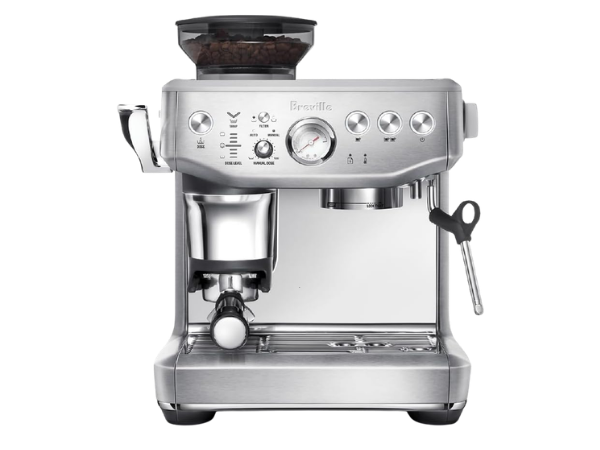
Breville Barista Express
| Type | Semi-Automatic Espresso Machine |
|---|---|
| Grinder | Integrated Precision Conical Burr Grinder |
| Grinding | Precise Dose Grinding |
| Extraction | Digital Temperature Control (PID) |
| Pre-Infusion | Low Pressure Pre-Infusion |
| Milk System | Manual Steam Wand |
| Grind Adjustment | Integrated Grind Size Dial |
| Capacity | 1 cup |
| Color | Brushed Stainless Steel |
| Dimensions | 13.8″D x 12.5″W x 15.9″H |
| Best For | Beginners & Hands-On Espresso |
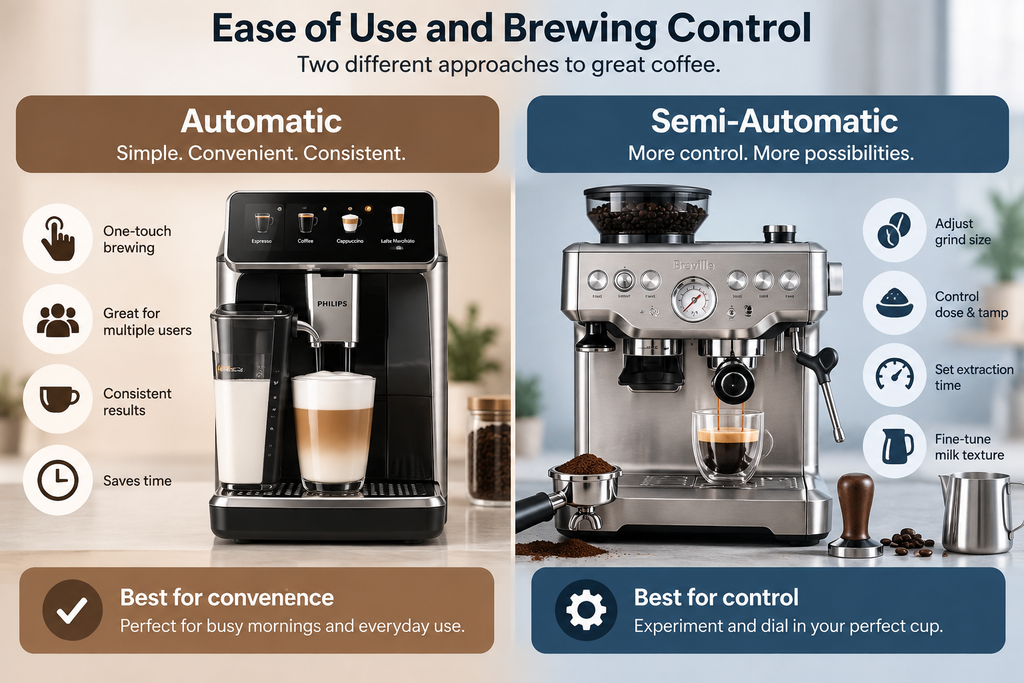
Ease of Use and Brewing Control
Ease of use is one of the biggest differences between automatic and semi-automatic coffee machines.
Automatic Coffee Machines
Automatic models are generally easier for beginners. Once the machine is configured, you can often prepare coffee with the push of a button.
This is particularly useful when:
- You make several drinks every morning.
- Multiple people use the same machine.
- You want consistent results without extensive practice.
- You have limited time for coffee preparation.
The trade-off is reduced control. Although many machines allow you to adjust settings such as grind size, coffee strength, temperature, or volume, you normally work within the options provided by the manufacturer.
Semi-Automatic Coffee Machines
Semi-automatic machines require more skill but provide greater control.
You can experiment with:
- Coffee dose
- Grind size
- Distribution
- Tamping pressure
- Extraction time
- Brew ratio
- Milk texture
Small adjustments can significantly change the flavor of an espresso. This makes semi-automatic machines attractive to coffee drinkers who enjoy dialing in different beans.
Coffee Quality and Espresso Extraction
Both machine types can make high-quality espresso. The machine alone, however, does not determine the final result.
Coffee freshness, grinder quality, grind size, dose, water temperature, extraction time, and the beans themselves all play important roles.
A good semi-automatic setup can provide exceptional control over espresso extraction. You can change the grind and dose based on the coffee you are using and adjust the shot as you taste the results.
Automatic machines can also produce very good espresso, particularly when they have a quality grinder and adjustable brewing settings. Their advantage is consistency and repeatability rather than maximum manual control.
| Espresso Factor | Automatic | Semi-Automatic |
|---|---|---|
| Consistency | Excellent with proper settings | Depends more on user technique |
| Manual adjustment | Limited to moderate | High |
| Experimentation | Moderate | Excellent |
| Repeatability | Very convenient | Requires consistent technique |
| Learning potential | Lower | Higher |
If your goal is to explore espresso preparation and fine-tune every variable, a semi-automatic machine usually gives you more room to experiment.
Grinder, Dosing, and Brewing Features
Grinding and dosing are particularly important because espresso requires a precise grind and coffee dose.
Many automatic coffee machines include a built-in burr grinder. The machine can grind beans immediately before brewing and deliver a programmed amount of coffee to the brewing chamber.
This creates a convenient all-in-one system and eliminates the need for a separate grinder.
With a semi-automatic machine, the grinder is commonly a separate appliance. This can increase the initial cost and take up more counter space, but it also gives you more flexibility.
A dedicated espresso grinder may offer more precise grind adjustment, which can be valuable when working with different beans.
Automatic machines often offer:
- Built-in grinders
- Programmable coffee strength
- Adjustable beverage volume
- One-touch brewing
- Pre-programmed recipes
- Automatic dosing
Semi-automatic machines typically offer:
- Manual dosing
- Adjustable grind settings through a separate grinder
- Greater control over coffee quantity
- Manual shot timing
- More flexibility for experimenting with recipes
If convenience is your priority, an automatic machine has the advantage. If grinder and dosing control are important to you, a semi-automatic setup may be more rewarding.
Milk Frothing and Drink Options
Milk preparation is another area where automatic and semi-automatic machines can differ significantly.
Many higher-end automatic machines feature integrated milk systems. You can select drinks such as cappuccino, latte, or flat white, and the machine handles much of the milk preparation automatically.
This is convenient for households where different people prefer different coffee drinks.
Semi-automatic machines generally use a steam wand. You manually steam the milk and control the amount of air introduced into it. With practice, this allows you to create different textures for cappuccinos, lattes, and other espresso-based drinks.
Automatic milk system
Pros:
- Fast preparation
- Convenient for beginners
- Consistent milk-based drinks
- Useful for one-touch recipes
Cons:
- Less control over milk texture
- Milk systems can require additional cleaning
- Some systems have more components to maintain
Manual steam wand
Pros:
- Excellent control over milk texture
- Better for learning café-style steaming
- More flexibility with different milk drinks
- Simple workflow on many machines
Cons:
- Requires practice
- Takes more time
- Results depend on technique
For convenience, automatic milk systems are hard to beat. For developing barista skills, a manual steam wand offers much more control.
Cleaning and Maintenance Requirements
Neither type of espresso machine is maintenance-free. Regular cleaning is essential for coffee flavor, machine performance, and hygiene.
Automatic machines often have more internal components because they may grind, brew, rinse, and prepare milk automatically. Many models therefore include automatic cleaning or rinsing programs.
However, automatic cleaning does not mean you can ignore maintenance. You may still need to empty the grounds container, refill the water tank, clean the brewing system, and maintain the milk components.
Semi-automatic machines usually have a more straightforward daily routine, but more of the cleaning is manual.
| Maintenance Task | Automatic | Semi-Automatic |
|---|---|---|
| Automatic rinsing | Common | Less common |
| Milk-system cleaning | May be extensive | Usually manual |
| Portafilter cleaning | Not usually required | Regular |
| Steam-wand cleaning | Depends on system | Required after steaming |
| Internal maintenance | Can be more complex | Generally more straightforward |
| Daily user involvement | Lower | Higher |
The important point is that automatic does not necessarily mean maintenance-free. It usually means that more cleaning steps are guided or automated by the machine.
Automatic vs Semi-Automatic: Which One Should You Choose?
The right machine depends on how you want to make coffee.
Choose an automatic coffee machine if you want:
- Fast, convenient brewing
- One-touch coffee preparation
- Less manual work
- Consistent results
- Built-in grinding
- Easy access to multiple drink recipes
Choose a semi-automatic coffee machine if you want:
- More control over espresso extraction
- Greater flexibility with coffee beans
- Manual dosing and tamping
- Better control over milk texture
- A more traditional espresso-making experience
- The opportunity to develop barista skills
Ultimately, there is no universal winner. Automatic machines are better suited to people who want convenience and repeatable drinks, while semi-automatic machines are better for coffee enthusiasts who enjoy control and customization.