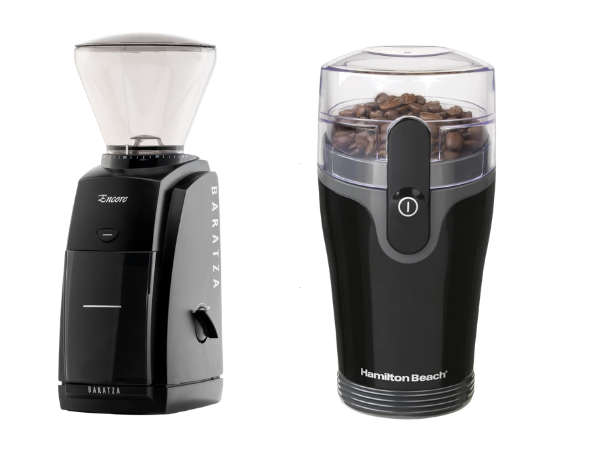
Choosing a coffee grinder can seem simple until you compare the two most common options: burr grinders and blade grinders. Both turn whole coffee beans into grounds, but they do it in very different ways.
Burr vs Blade Grinder: What’s the Difference?
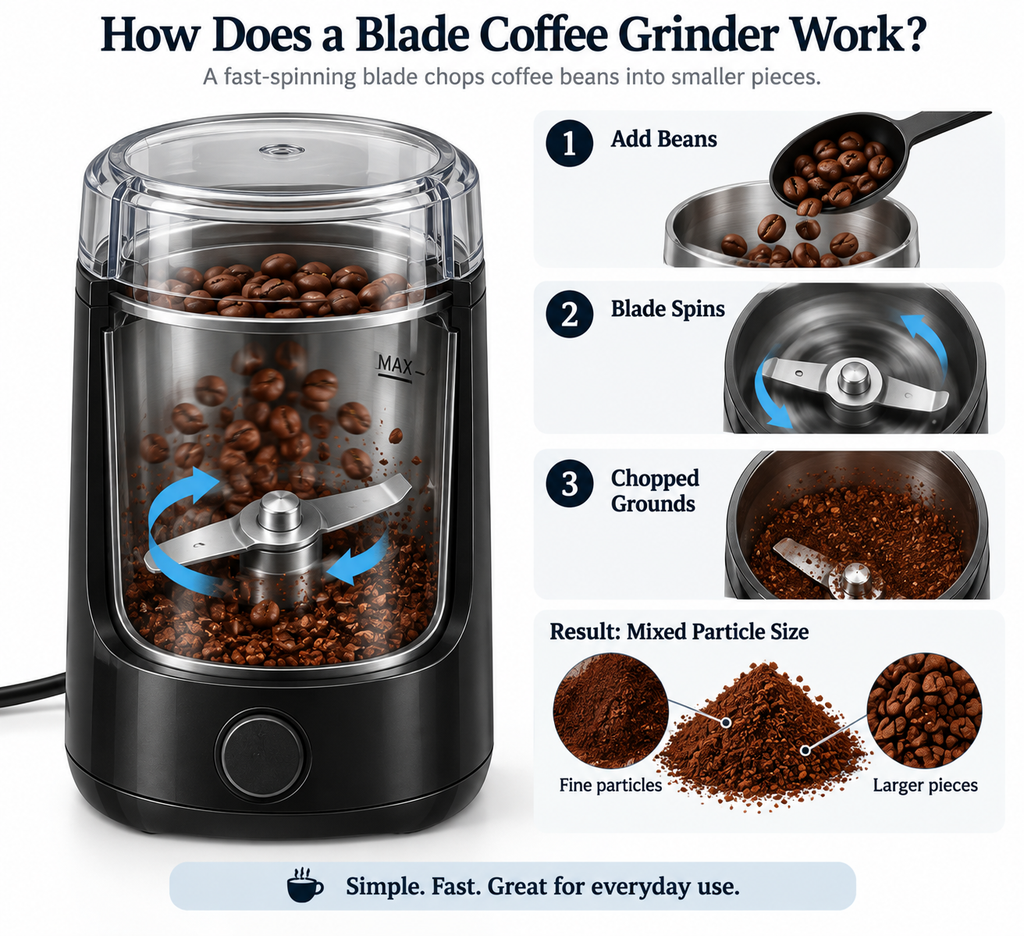
A blade grinder has a small motor that spins one or more sharp blades at high speed. The blades chop the beans into progressively smaller pieces. Because the user generally controls the grinding process by running the motor for a certain amount of time, grind size is difficult to reproduce precisely.
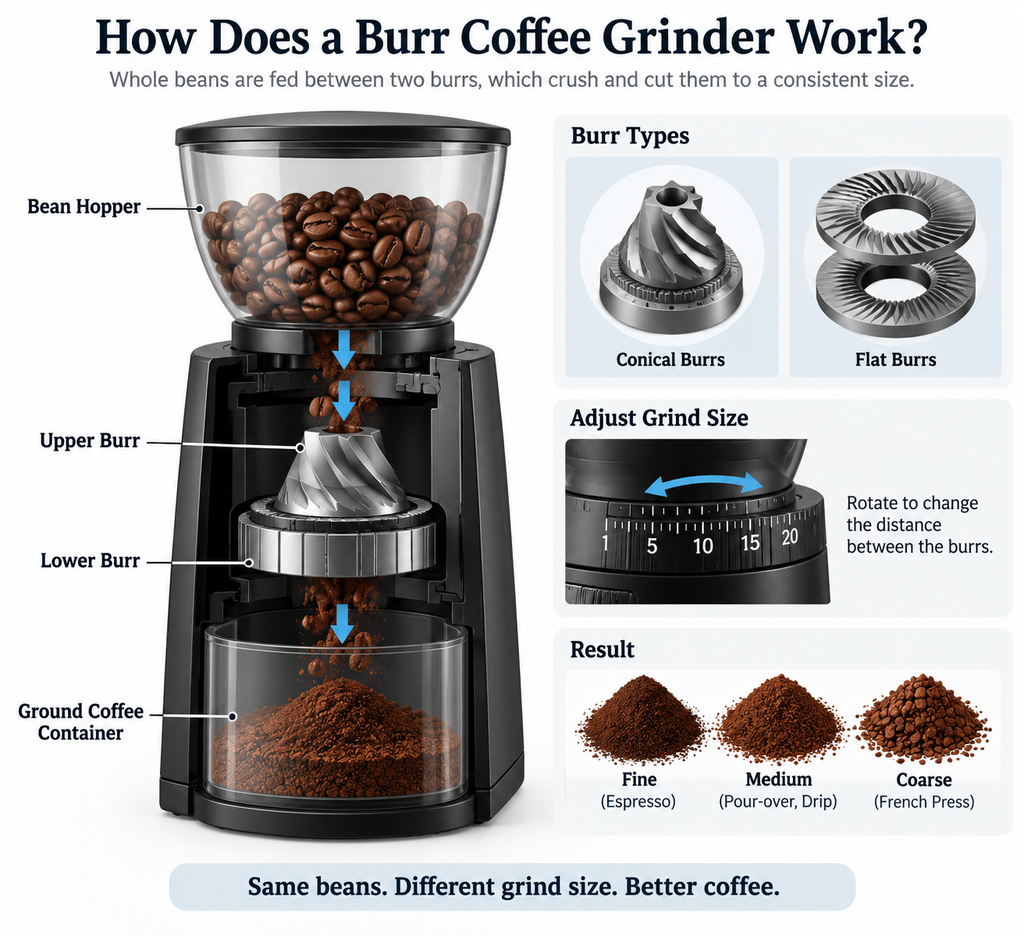
A burr grinder uses two burrs with textured grinding surfaces. Coffee beans pass between the burrs and are broken down according to the distance between them. Changing that distance changes the resulting grind size.
This gives burr grinders a major advantage: grind size can be adjusted deliberately rather than estimated primarily by grinding time.
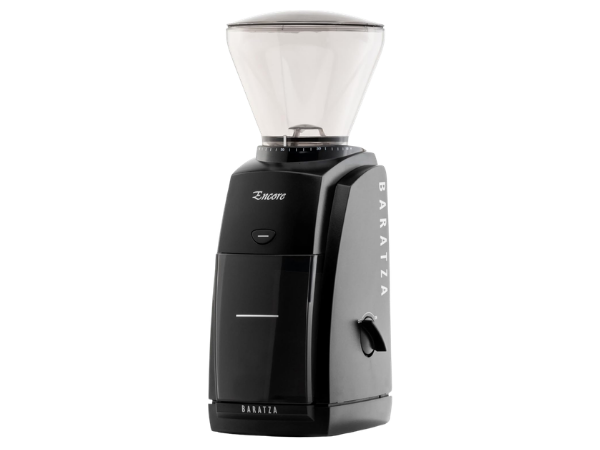
Baratza Encore
| Grinder Type | Conical Burr Grinder |
|---|---|
| Burr Material | Steel |
| Burr Size | 40 mm |
| Grind Settings | 40 |
| Material | Plastic |
| Style | Automatic |
| Item Weight | 5.6 pounds |
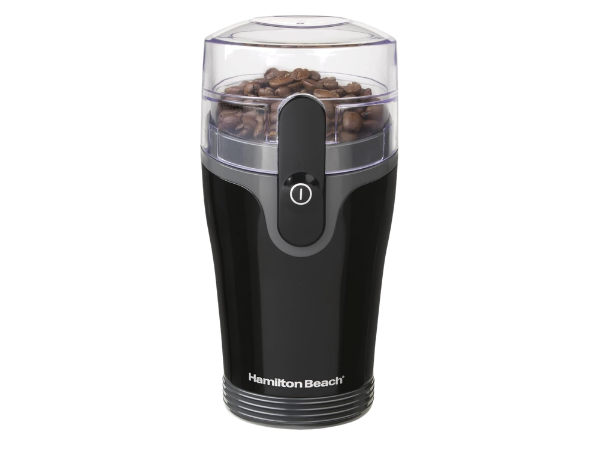
Hamilton Beach Fresh Grind
| Grinder Type | Blade Grinder |
|---|---|
| Blade Material | Stainless Steel |
| Grind Settings | Time-based control |
| Capacity | Up to 12 cups |
| Material | Plastic & stainless steel |
| Style | Standard |
| Item Weight | 1.3 pounds |
How Does a Burr Coffee Grinder Work?
A burr grinder uses two grinding surfaces called burrs. Depending on the grinder, these may be flat or conical.
With flat burrs, two roughly parallel rings grind the beans between them. With conical burrs, a cone-shaped burr works inside a matching outer burr. Both designs are widely used in home coffee grinders.
When whole beans enter the grinding chamber, the burrs break them down as they move through the gap. The distance between the burrs determines the target grind size.
How Does a Blade Coffee Grinder Work?
Inside the grinding chamber is a rotating blade. When the motor is activated, the blade spins rapidly and strikes the coffee beans, breaking them into smaller pieces.
Unlike a burr grinder, there is generally no precise mechanism that holds the beans at a predetermined grinding gap.
Instead, the resulting grind depends heavily on factors such as:
- How long the grinder runs
- How many beans are in the chamber
- How the beans move around the blades
- The grinder’s blade design
- How frequently the user stops and checks the grounds
Running the grinder longer generally produces finer grounds, but this doesn’t mean every particle reaches the same size.
Burr vs Blade Grinder: Grind Consistency Compared
Grind consistency is the biggest reason burr grinders generally outperform blade grinders.
Imagine two cups of ground coffee. The first contains particles that are relatively close in size. The second contains a mixture of very fine particles and much larger pieces.
When water passes through those grounds, the particles do not all extract at the same rate.
Very small particles can extract quickly, while larger particles generally take longer. A wide particle-size distribution can therefore contribute to simultaneous over- and under-extraction.
That can make the coffee taste less balanced and make it harder to reproduce a recipe from one brew to the next.
Which Grinder Makes Better-Tasting Coffee?
When it comes to flavor, the grinder you choose can make or break your cup. Burr grinders are celebrated for producing clean, balanced brews with distinct flavor notes, while blade grinders often yield muddled results due to uneven particle sizes.
- Flavor Clarity – Burr grinders highlight subtle tasting notes like fruit, chocolate, or floral tones.
- Bitterness Control – Blade grinders often over‑extract fine particles, resulting in harsh flavors.
- Balance – Burr grinders deliver smoother, more consistent cups.
- Brewing Versatility – Burr grinders adapt to espresso, pour‑over, French press, and cold brew.
- Casual Use – Blade grinders may suffice for quick, everyday drip coffee.
In practice, burr grinders consistently outperform blade grinders for taste. They allow you to experience the full character of your beans, whether it’s a bright Ethiopian roast or a deep, chocolatey Colombian.
Burr vs Blade Grinder: Price, Speed & Ease of Use
Blade grinders are appealing because they’re inexpensive and fast, making them a popular entry‑level option. Burr grinders, on the other hand, are more expensive but deliver superior performance and durability.
- Price Comparison – Blade grinders typically cost $20–$40, while burr grinders range from $80 to $300+, depending on quality and features.
- Speed – Blade grinders can grind beans in seconds; burr grinders take longer but produce consistent results.
- Ease of Use – Blade grinders are simple one‑button devices, while burr grinders require adjusting grind settings.
- Maintenance – Burr grinders need regular cleaning to prevent oil buildup; blade grinders are easier to wipe down.
In practice, blade grinders win on affordability and speed, making them suitable for casual drinkers who want quick coffee without fuss.
Burr vs Blade Grinder: Which Is Better for Home Coffee?
For home coffee enthusiasts, the choice between burr and blade grinders often comes down to priorities. Burr grinders are the go‑to for those who want café‑quality flavor, consistency, and control.
- Flavor Quality – Burr grinders consistently deliver superior taste, while blade grinders risk bitterness.
- Brewing Flexibility – Burr grinders adapt to espresso, pour‑over, French press, and cold brew; blade grinders are best for drip coffee.
- Cost Consideration – Blade grinders are budget‑friendly, burr grinders are an investment.
- Ease of Use – Blade grinders are simple one‑button devices; burr grinders require adjustments but offer precision.
- Long‑Term Value – Burr grinders last longer and maintain performance, making them more cost‑effective over time.
In the end, burr grinders are better suited for anyone serious about coffee and willing to invest in quality. Blade grinders remain a practical option for those who want quick, inexpensive coffee without fuss.