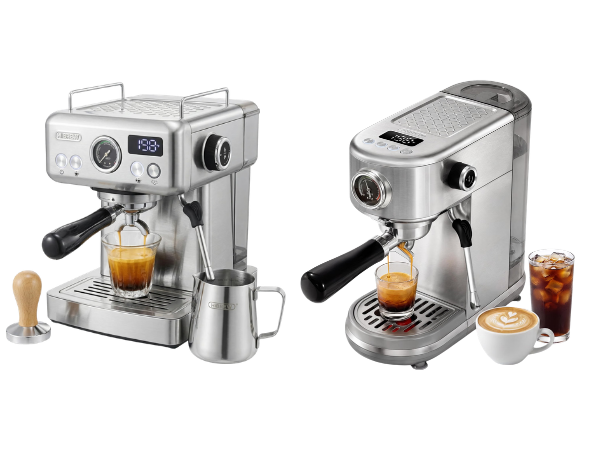
The HiBREW H10A and H10B are semi-automatic espresso machines designed for home brewing, with programmable settings, pressure gauges, adjustable temperature, and steam wands.
HiBREW H10A vs H10B: Key Specifications
The HiBREW H10A and H10B share several core espresso features, but they differ in size, water capacity, controls, and brewing adjustments.
| Feature | HiBREW H10A | HiBREW H10B |
|---|---|---|
| Machine type | Semi-automatic | Semi-automatic |
| Pump pressure | 20 bar | 20 bar |
| Water tank | 1.8 L | 1.3 L |
| Steam temperature | 125–150°C | Adjustable |
| Pre-infusion | Adjustable, 0–10 sec. | Programmable |
| Steam wand | 270° rotating | 270° rotating |
| Portafilter | 58 mm | Standard H10B configuration |
| Display | LCD/LED display with shot timer | Digital interface |
The basic brewing platform is similar, including 20-bar pressure, adjustable temperature, pre-infusion, and steam functions. The main differences are in the machine size, water capacity, interface, and brewing control.
1. Design and Build Quality
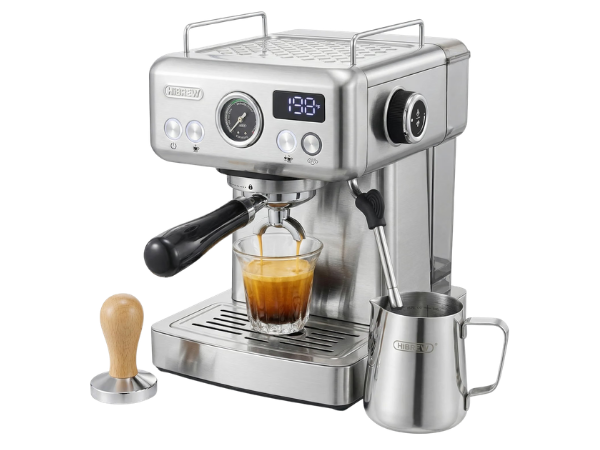
The HiBREW H10A and H10B have a similar stainless-steel design, but they are made for slightly different kitchen setups. The H10A provides more water capacity, while the H10B takes up less space.
- H10A: 1.8-liter water tank
- H10B: 1.3-liter removable water tank
- H10A: larger countertop design
- H10B: slimmer and more compact body
- Both use a stainless-steel exterior
The main difference is simple: the H10A is better suited to higher-volume use, while the H10B is easier to fit into a smaller coffee station.
2. Espresso Brewing Performance
The HiBREW H10A and H10B offer similar core brewing capabilities, including a 20-bar pump, adjustable temperature, pre-infusion, and cold extraction. The H10A, however, provides more control over the brewing process.
- H10A: 20-bar pump
- H10B: 20-bar pump
- Both: 90–95°C adjustable brewing temperature
- Both: 25°C cold-extraction setting
- H10A: adjustable pre-infusion from 0–10 seconds
- H10A: 58mm portafilter with non-pressurized baskets
- H10B: programmable extraction settings and pressure gauge
For users who like to fine-tune espresso shots, the H10A offers more adjustment options, while the H10B provides the essential controls for everyday espresso brewing.
3. Temperature Control and Heating System
Both the HiBREW H10A and H10B let you adjust the brewing temperature, giving you more flexibility than a basic espresso machine with fixed settings. The H10A adds more advanced temperature-management features.
- H10A: PID temperature control
- H10A: thermoblock heating system
- H10A: automatic temperature surfing
- H10B: adjustable brewing temperature
- Both: 90–95°C brewing range
- Both: 25°C cold-extraction setting
The main difference is that the H10A offers more advanced temperature control, while the H10B keeps the process simpler with adjustable brewing settings.
4. Pressure and Extraction Features
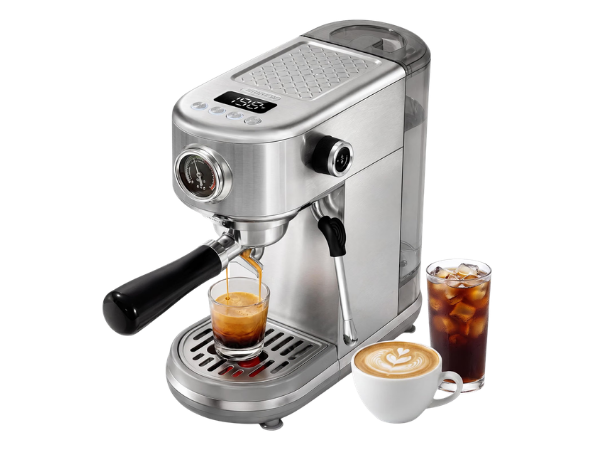
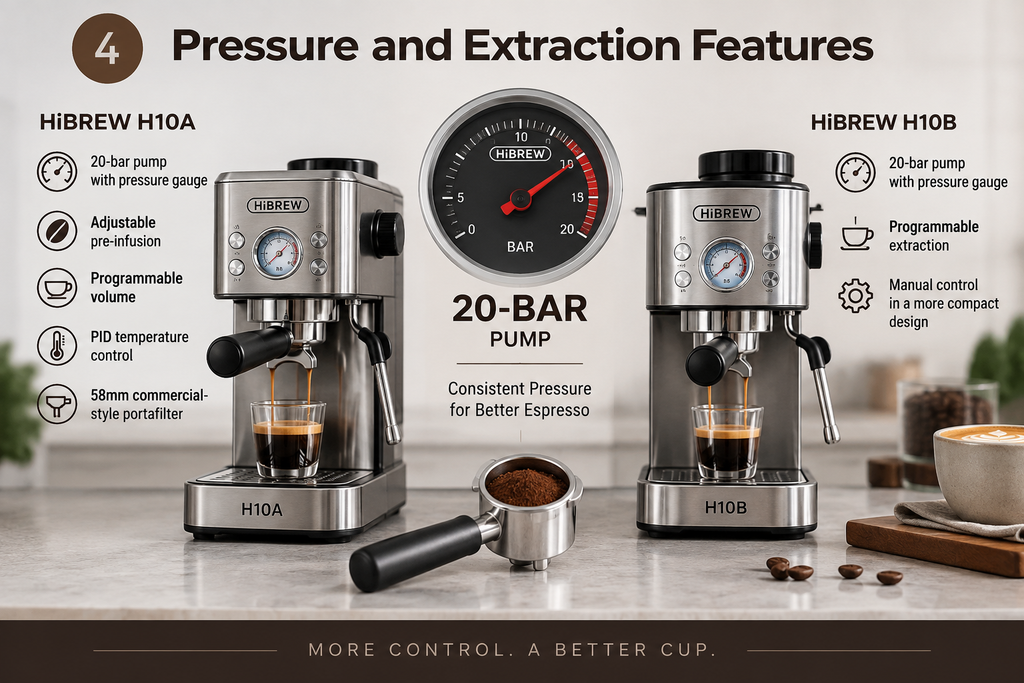
Both machines are equipped with a 20-bar pump and a visible pressure gauge. This allows users to monitor extraction pressure while making espresso.
The H10A combines pressure control with adjustable pre-infusion, programmable volume, PID temperature control, and a 58mm commercial-style portafilter. This gives users several variables to adjust when dialing in a shot.
The H10B keeps many of these core functions while using a smaller overall design. Its programmable extraction and pressure gauge make it suitable for users who want manual control without moving to a much larger espresso machine.
5. Grinder and Coffee Preparation
Neither the HiBREW H10A nor H10B has a built-in coffee grinder. You need to use pre-ground coffee or pair the machine with a separate grinder.
This can actually be useful for espresso enthusiasts because a separate grinder allows more control over grind size. The H10A comes with a 58mm portafilter and non-pressurized baskets, giving users more flexibility when working with freshly ground coffee.
For the best results with either machine, grind size, dose, distribution, and tamping should be adjusted together rather than relying only on the machine’s pressure rating.
6. Milk Frothing and Steam Performance
Both models are designed for milk-based drinks such as cappuccinos and lattes. The H10A has a 270-degree rotating steam wand and adjustable steam temperature from 125°C to 150°C. HiBREW also highlights its ability to create microfoam for latte art.
The H10B uses a 270-degree steam system as well and is designed to produce thick milk foam. Its steam function can be adjusted separately from the coffee brewing temperature.
The two machines therefore offer a similar approach to milk steaming. The H10A provides more detailed documentation around steam-temperature adjustment and temperature management.
7. Controls, Ease of Use, and Extra Features
The HiBREW H10A offers a more feature-focused control system, while the H10B keeps the controls simpler. Both machines provide useful settings for everyday espresso preparation.
- H10A: multifunctional display with shot timer
- H10A: adjustable temperature, volume, and pre-infusion
- H10A: hot-water dispensing
- H10A: cup-warming area
- H10B: programmable extraction
- H10B: adjustable temperature
- H10B: pressure gauge
- Both: rotating steam wand
The H10A offers more control and extra features, while the H10B is a simpler, more compact option for users who want the essential espresso functions without as many adjustments.
HiBREW H10A vs H10B: What’s the Price Difference?
At the time of checking the official HiBREW USA store, the H10A was listed at $199.00, compared with $139.99 for the H10B. That puts the H10A about $59 more expensive at the listed sale prices. Prices can change depending on promotions, region, and plug version.
| Model | Listed price | Water tank | Main advantage |
|---|---|---|---|
| HiBREW H10A | $199.00 | 1.8 L | More brewing control and larger capacity |
| HiBREW H10B | $139.99 | 1.3 L | Lower price and compact design |
The HiBREW H10A vs H10B comparison therefore comes down to priorities rather than simply choosing the newer or more expensive-looking machine. The H10A offers a larger tank, 58mm portafilter, PID temperature control, more detailed programming, and a more extensive control system.